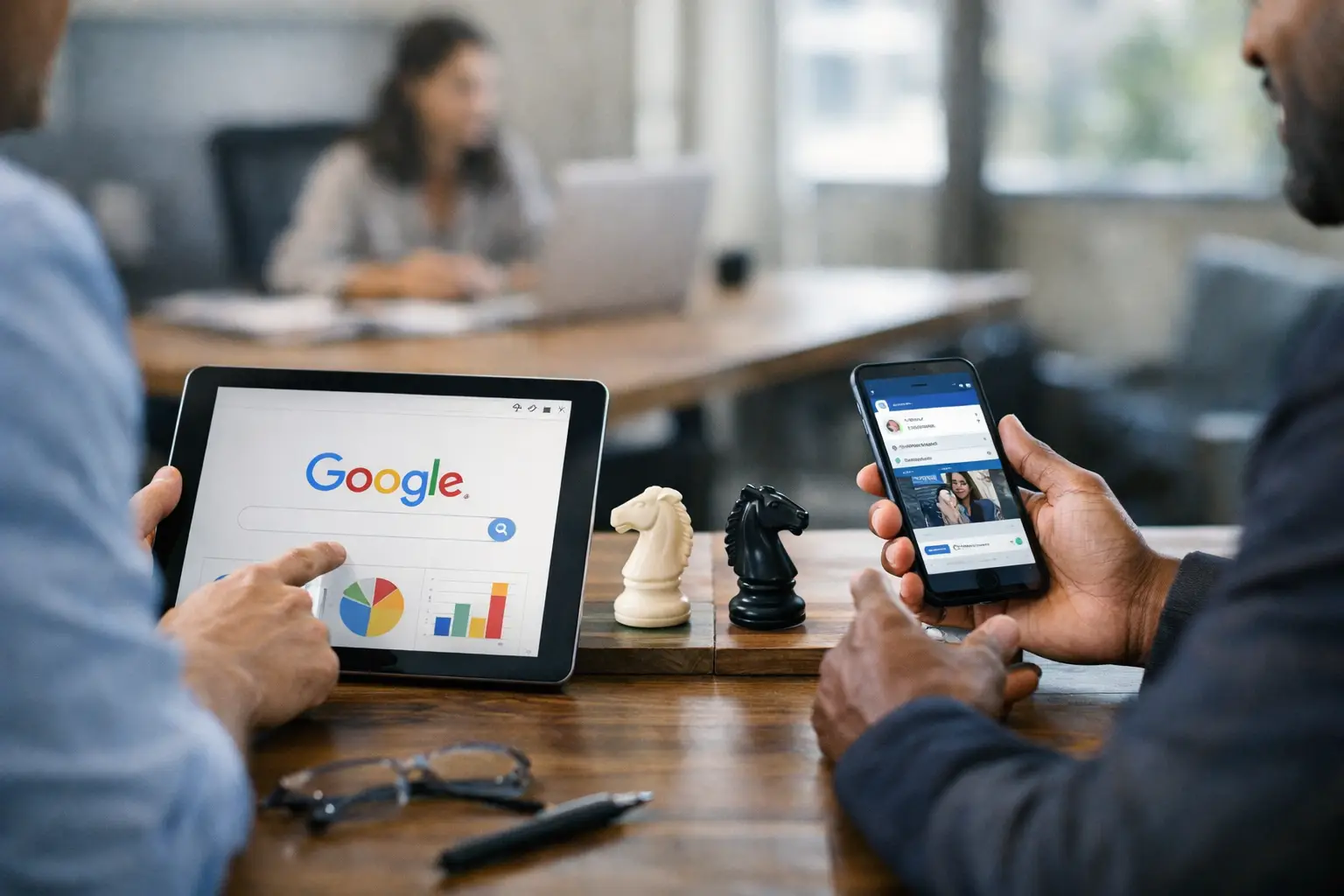
A prospect searching “emergency plumber Raleigh” is already raising their hand. A homeowner scrolling past a kitchen renovation video may not be thinking about remodeling at all – until the right ad makes them picture a better space. That difference is the heart of Google Ads vs Facebook Ads.
Both platforms can produce real leads and sales. Both can also chew through budget when the strategy stops at “run some ads.” The better choice depends on how your customers buy, how urgently they need you, what you sell, and whether your website can turn attention into action.
For most small and mid-sized businesses, the strongest answer is not blind loyalty to one channel. It is a clear plan for matching the platform to the moment your buyer is in.
Google Ads vs Facebook Ads: The Core Difference
Google Ads captures demand. Facebook Ads, now managed through Meta’s advertising platform, creates and nurtures demand.
When someone types a query into Google, they are telling you what they want right now. Searches such as “commercial HVAC repair near me,” “Raleigh divorce attorney,” or “best accounting software for contractors” come with intent. Google Ads puts your business in front of people actively looking for a solution, often near the point of contact or purchase.
Facebook Ads works differently. People are on Facebook and Instagram to catch up with friends, watch videos, browse products, and fill spare minutes. They are not usually searching for your service. Your ad has to earn attention, create relevance, and give them a reason to take the next step.
Neither behavior is better. They are different jobs. Google is often the closer. Facebook is often the conversation starter.
When Google Ads Is the Better Lead Generation Channel
Google Ads is usually the first paid channel to test when your service solves a clear, urgent, searchable problem. Think roof leaks, pest control, legal representation, IT support, medical appointments, restoration work, moving services, or B2B services with defined needs.
The advantage is speed to intent. If a business owner searches for “managed IT services Raleigh,” they have likely moved beyond casual awareness. A focused ad, a trustworthy landing page, a relevant offer, and a simple contact path can turn that search into a qualified inquiry quickly.
Google also gives you unusually direct control over message matching. A person searching for “WordPress web design agency” should land on a page about WordPress web design, not a generic homepage that makes them hunt for answers. That alignment improves relevance, conversion rates, and the quality of your leads.
Still, high intent does not mean easy wins. The most valuable keywords can be expensive, especially in law, home services, healthcare, financial services, and competitive B2B markets. Broad match keywords, weak negative keyword lists, or a campaign with no geographic discipline can bring a flood of clicks from people who will never become customers.
Google Ads works best when you know what a qualified lead looks like. If a job needs to be within a certain service area, meet a minimum project value, or involve a specific service, your campaigns and landing pages should say so. Paying for clicks is one thing. Paying for bad-fit leads is another.
Google Ads is a strong fit when:
Your customers search for your offering, need an answer soon, and can understand the value of contacting you from a short, direct message. It also performs well when you have a high enough customer value to support the cost of acquisition.
A $20 click may feel painful for a low-margin product. It can be a smart investment when one closed lead is worth $5,000, $20,000, or more. The math matters more than the click price.
When Facebook Ads Is the Better Growth Channel
Facebook and Instagram ads shine when your offer is visual, emotional, educational, or not commonly searched for by name. They are especially effective for eCommerce brands, home improvement companies, aesthetic services, fitness programs, real estate, events, local brands, and businesses with a compelling before-and-after story.
The targeting options allow advertisers to reach audiences based on location, interests, behaviors, customer lists, and engagement. More importantly, the platform gives you room to show the transformation behind the offer. A great remodeling campaign can show a dated bathroom becoming a space someone wants to live in. A B2B campaign can use a short video to name the costly operational problem prospects have been tolerating.
That creative advantage comes with a trade-off: people are not actively asking for what you sell. Your ad needs a stronger hook, clear positioning, and an offer that matches the level of commitment you are requesting.
Asking someone to book a $15,000 project consultation after one cold ad is possible, but it is rarely the most efficient path. Offering a project guide, a free estimate, a style quiz, a consultation, or a useful checklist can be a smarter first step. Then your follow-up process can move that prospect toward a sale.
Facebook Ads also excels at remarketing. Someone who visited your service page, watched a video, added a product to a cart, or started a form has already shown interest. A well-timed follow-up ad can bring them back when they are ready to act.
Facebook Ads is a strong fit when:
You can make the benefit easy to see, your audience can be defined beyond a keyword search, and you have the patience to build trust before demanding the sale. It is also a powerful tool for staying visible to people who have already encountered your brand.
The catch is that audience targeting is not a substitute for a real message. “Homeowners in Raleigh” is not a strategy. Why should those homeowners care? What problem do they recognize? What outcome do they want? Why should they trust you instead of scrolling on?
Your Landing Page Can Make Either Platform Fail
The platform is only one piece of the lead generation system. A sharp ad that sends visitors to a slow, vague, cluttered website is a budget leak.
Google visitors want fast confirmation that they found the right answer. Put the service, location, proof, benefits, and next step where they can see them immediately. Facebook visitors may need more context, so use strong visuals, social proof, a clear explanation, and a low-friction conversion path.
In both cases, remove unnecessary detours. Do not make a prospect click through five pages to request a quote. Do not bury your phone number. Do not ask for twelve form fields when four will do. Every extra ounce of friction gives a motivated visitor a reason to leave.
This is why paid media and conversion rate optimization belong together. At Capstone Design Group, we look beyond impressions and clicks because the real question is whether the traffic turns into profitable opportunities. More visitors do not fix a page that fails to persuade.
Budget, Sales Cycle, and Measurement Matter More Than Platform Hype
A business with a limited budget should usually avoid spreading spend across every possible campaign type. Start where the evidence is strongest.
If you offer an urgent, highly searchable service, prioritize a tightly managed Google Search campaign. If you sell a visual product or need to introduce a new offer, begin with Facebook or Instagram creative that tests different pain points and outcomes. If your sales cycle is longer, use both strategically: Facebook to build familiarity and remarket, Google to capture buyers when they begin searching.
Do not judge performance by cheap clicks or a vanity-level cost per lead. A $15 Facebook lead that never answers the phone is not better than a $90 Google lead that turns into a $10,000 project. Track calls, form submissions, booked appointments, qualified opportunities, closed revenue, and customer acquisition cost whenever possible.
There is also no universal “good” conversion rate or cost per lead. A local chiropractor, a custom home builder, and a B2B software company operate with different margins, timelines, and definitions of a valuable customer. Your benchmarks need to reflect your business model, not someone else’s dashboard screenshot.
A Practical Way to Choose Your Starting Point
Ask one honest question: are people already searching for the problem we solve?
If the answer is yes, Google Ads deserves serious attention. Build campaigns around high-intent searches, protect your budget with negative keywords, and send each ad group to a relevant landing page.
If the answer is no, or if your market needs to see and understand the value before they act, Facebook Ads may be the better starting point. Lead with compelling creative, test your message, and give prospects a sensible next step rather than forcing an immediate commitment.
If the answer is both, do not treat the platforms as rivals. Use Facebook to create awareness, build audiences, and bring past visitors back. Use Google to show up when intent becomes explicit. The combination can be especially effective for higher-consideration services where buyers research, compare, hesitate, and return more than once.
The helpful next step is not picking a platform because it is popular. Map your buyer’s path, calculate what a qualified customer is worth, and make sure the page behind every ad gives that buyer a confident reason to contact you. That is how ad spend becomes a growth engine instead of another line item you are tired of explaining.